 (Image generated by AI)
The Alphabet Soup of Canadian Finance
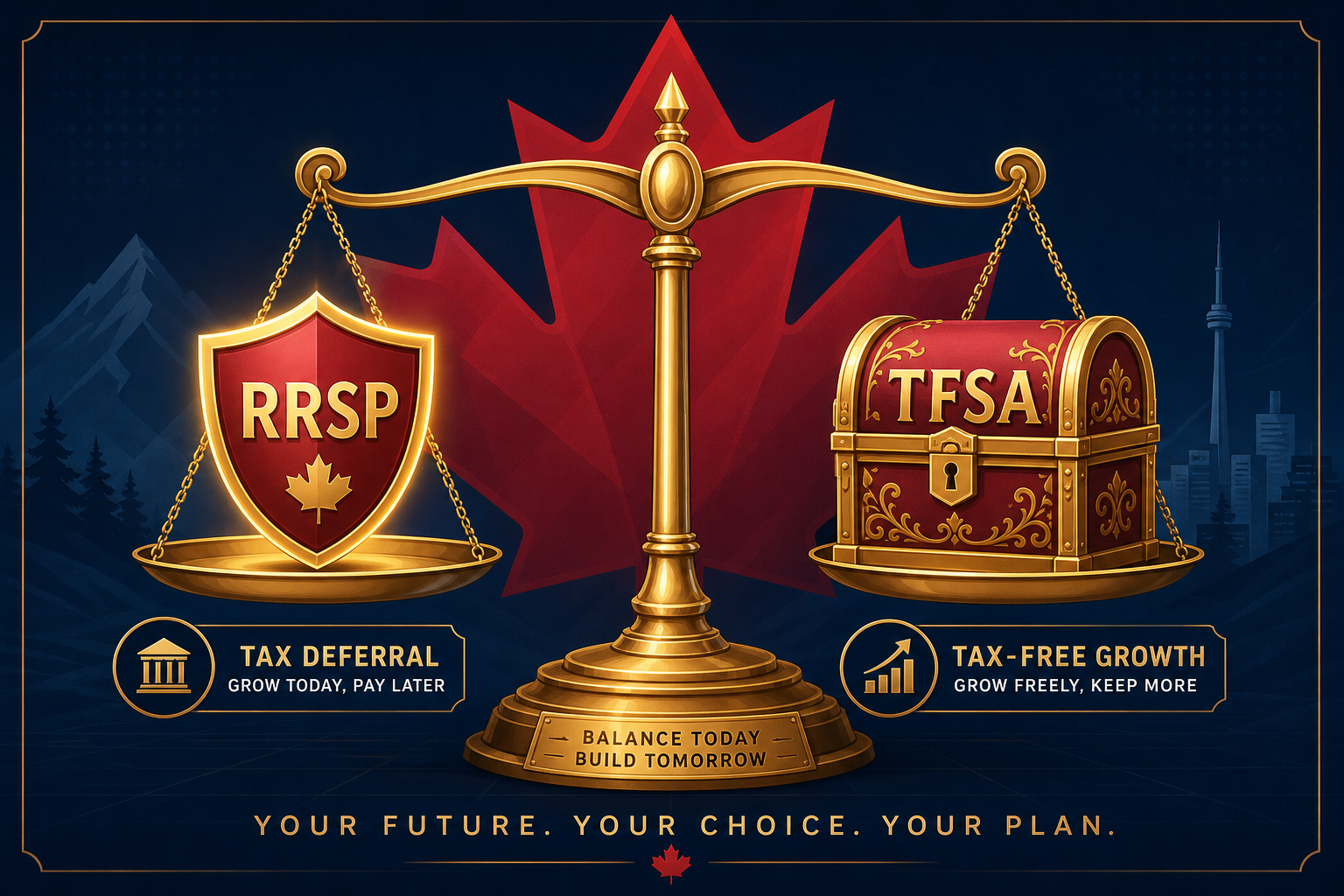
If you live in Canada and want to save money, the government has created an alphabet soup of accounts for you to use. The two most famous are the TFSA (Tax-Free Savings Account) and the RRSP (Registered Retirement Savings Plan).
We already covered the TFSA in a previous guide. It’s incredibly flexible and tax-free. So why does the RRSP even exist? And more importantly, which one should you fill up first?
Let’s break down the RRSP in plain English.
How the RRSP Actually Works: Tax Deferral
The magic of the RRSP is a concept called Tax Deferral. When you put money into an RRSP, the government pretends you never earned that money in the first place for that tax year.
Imagine you earn $80,000 a year. You decide to contribute $10,000 to your RRSP. When tax season arrives, the Canada Revenue Agency (CRA) will say, “Oh, you put $10k in your RRSP? Okay, we will calculate your income taxes as if you only earned $70,000 this year.”
Because you were likely taxed by your employer as if you made $80,000, the government realizes they overcharged you. They will send you a tax refund for the difference (usually a few thousand dollars).
The Catch: It’s Not Tax-Free!
The TFSA is completely tax-free forever. The RRSP is not. The government is giving you a tax break now, but they expect their money later. When you retire and withdraw that money from your RRSP to buy groceries, you will be taxed on it as if it were regular income.
You are simply deferring the tax to the future.
Why Deferring Tax is a Superpower
If you have to pay taxes on it eventually, what’s the point?
The entire strategy relies on your Tax Bracket. The goal is to contribute to your RRSP when you are making a lot of money (high tax bracket), and withdraw from it when you are retired and making very little money (low tax bracket).
The Math (Simplified)
- Today (Age 35): You earn $120,000/year. You are in a high tax bracket (let’s say 40%). You put $10k in the RRSP. You save $4,000 in taxes today.
- Retirement (Age 65): You are retired. Your only income is CPP/OAS. You withdraw $10k from your RRSP to go on vacation. Because your total income is so low, your tax bracket is only 20%. You pay $2,000 in taxes.
You effectively “beat” the government out of $2,000 purely through tax arbitrage!
RRSP vs TFSA: The Golden Rules
So, which one do you fund first? While everyone’s situation is unique, here are the general guidelines:
You should prioritize the TFSA if:
- You make less than $50,000 a year. Your tax bracket is already low. The tax refund from an RRSP won’t be very big, and you risk withdrawing it in retirement at a higher tax bracket.
- You might need the money soon. If you withdraw from an RRSP early, you lose that contribution room forever, and you are hit with a massive withholding tax. TFSA withdrawals are tax-free and the room comes back next year.
- You expect your income to rise significantly. Save your RRSP room for when you are in your peak earning years!
You should prioritize the RRSP if:
- You are a high-income earner ($90k+). The immediate tax refund is too powerful to ignore. Use the refund and reinvest it back into the market!
- Your employer offers an RRSP match. If your company says “We will match your RRSP contributions up to 5% of your salary,” that is literally free money. Always prioritize the employer match before doing anything else.
- You have US Dividend Stocks. Due to tax treaties, the RRSP is the only Canadian account that is exempt from the 15% US withholding tax on dividends (unlike the TFSA).
Conclusion
Neither account is “better” than the other; they are simply different tools in your financial toolbox. If you are young and starting your career, max out the TFSA. As your salary grows, switch your focus to the RRSP. If you are incredibly lucky (or disciplined) and max out both, congratulations—you’ve beaten the game.