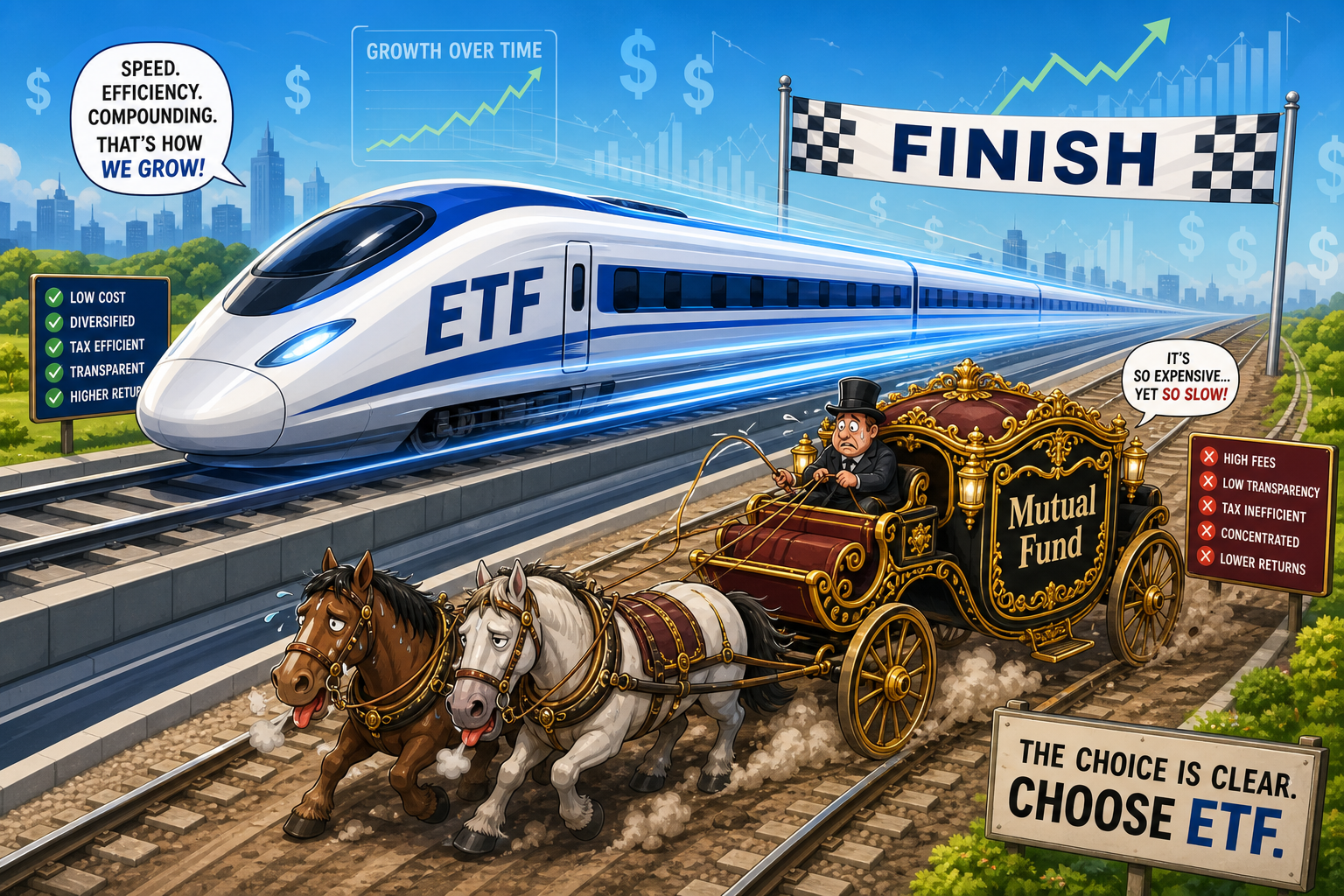
 (Image generated by AI)
The Hidden Killer in Your Portfolio
If you walk into a traditional Canadian bank branch today and say, “I have $10,000 and I want to invest for my retirement,” the financial advisor across the desk is almost guaranteed to sell you a Mutual Fund.
Twenty years ago, this was your only real option. Today, doing this is one of the most expensive financial mistakes you can make. The modern alternative is the ETF (Exchange-Traded Fund).
To understand why, we need to talk about the most boring but dangerous acronym in personal finance: the MER.
What is an MER?
MER stands for Management Expense Ratio. It is the fee that the mutual fund company charges you every single year to manage your money.
In Canada, the average Mutual Fund has an MER of around 2.0%. If you invest $100,000, you are paying the bank $2,000 every single year, regardless of whether the fund makes money or loses money.
“2% doesn’t sound that bad…”
Our brains are terrible at understanding compounding math over long periods of time. A 2% fee sounds tiny, almost negligible. Let’s look at the actual math over a 30-year career.
Imagine you and your friend both invest $500 a month for 30 years. You both earn a 7% average annual return on your investments.
- Your friend buys a broad-market ETF with an MER of 0.2%.
- You buy a bank Mutual Fund with an MER of 2.0%.
After 30 years:
- Your friend’s portfolio is worth: $563,000
- Your portfolio is worth: $394,000
You lost $169,000 to fees. You gave away nearly a third of your life’s savings to the bank just to hold your money. The 2% fee didn’t eat 2% of your wealth; due to the loss of compounding interest, it ate nearly 30% of your final outcome.
Mutual Funds vs ETFs: The Breakdown
Mutual Funds (The Expensive Carriage)
A Mutual Fund is a pool of money managed by a professional “Active Manager.” This manager spends all day researching companies, buying stocks they think will go up, and selling stocks they think will go down.
- Pros: Completely hands-off. You can set up automatic bank withdrawals and the manager does everything.
- Cons: Very high fees (typically 1.5% to 2.5%). As we discussed in our Index Investing guide, these active managers rarely actually beat the market average, making their high fees completely unjustified.
ETFs (Exchange Traded Funds) (The Bullet Train)
An ETF is also a pool of money, but instead of paying an expensive manager in a suit to pick stocks, the fund is managed by a computer algorithm that simply tracks an index (like the S&P 500). Furthermore, ETFs are traded on the stock exchange exactly like regular stocks. You can log into a brokerage app and buy them instantly during the day.
- Pros: Incredibly low fees (typically 0.05% to 0.25%). Highly transparent (you know exactly what companies the index holds). Historically better long-term performance than actively managed mutual funds.
- Cons: You have to buy them yourself through a brokerage app (like Wealthsimple or Questrade). It requires a tiny bit more DIY effort than walking into a bank branch.
Are Mutual Funds Always Bad?
To be fair, there is a time and a place for Mutual Funds. If the thought of opening a brokerage app and clicking “Buy” terrifies you, and you know for a fact that you will just leave your money sitting in a 0% checking account otherwise, then a 2% Mutual Fund is infinitely better than doing nothing.
However, in 2024, buying an ETF takes roughly 3 minutes on a modern smartphone. The “DIY” effort is incredibly minimal.
Conclusion
The financial industry makes billions of dollars relying on the fact that you think investing is too complicated to do yourself. It isn’t. By taking 20 minutes to open a low-cost brokerage account and buying broad-market ETFs instead of high-fee Mutual Funds, you can literally save yourself hundreds of thousands of dollars over your lifetime.