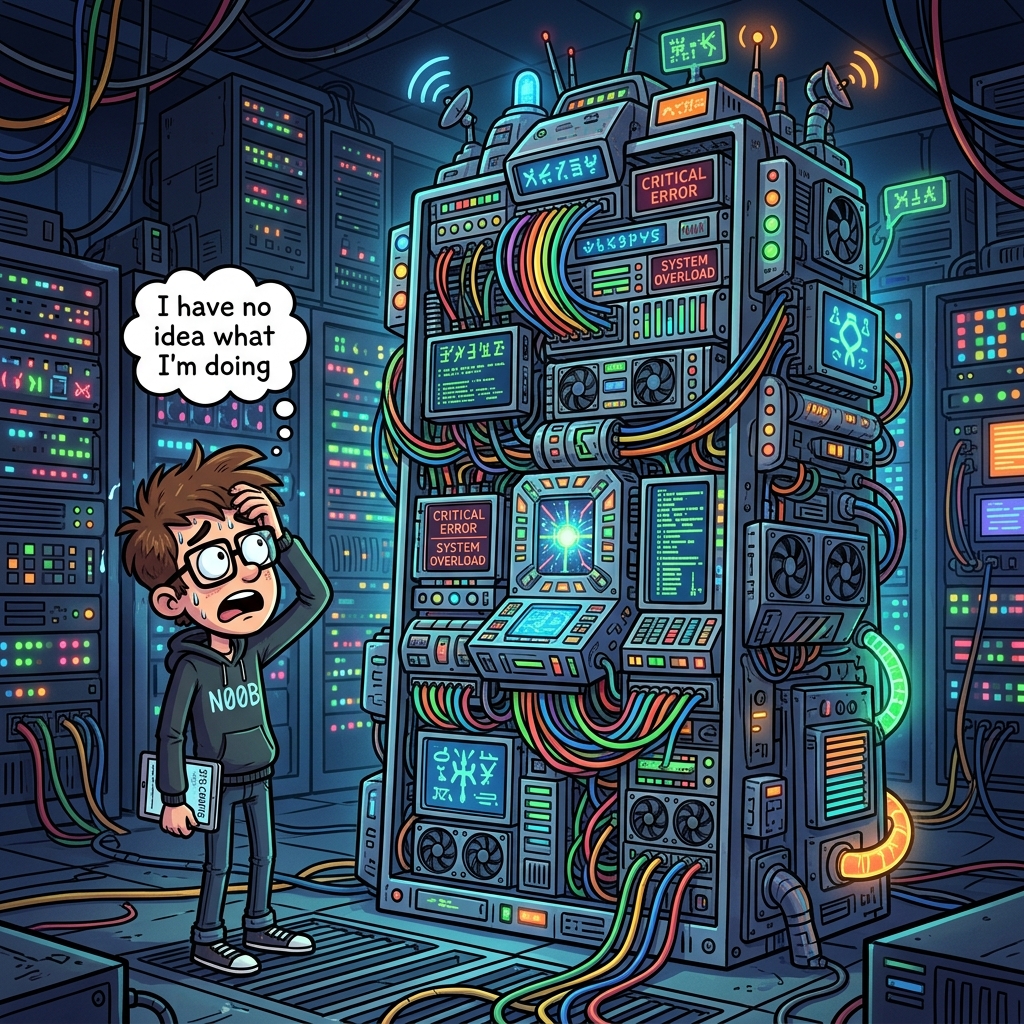
 (Image generated by AI)
The Universal Secret: We Are All Googling It
Welcome to the exciting world of Software Engineering, where you can spend six hours debugging a system failure only to realize you forgot a single semicolon. If you’ve ever stared at a massive, tangled web of legacy code and thought, “I have absolutely no idea what I’m doing, and today is the day they finally find out,” take a deep breath.
You are experiencing Imposter Syndrome. And here’s the best part: so is the Senior Developer sitting next to you.
Imposter Syndrome is the nagging psychological pattern where you doubt your own accomplishments and have a persistent, internalized fear of being exposed as a “fraud.” In tech, this is practically a feature, not a bug.
Why Developers Get It So Bad
1. The Fast-Paced Tech Cycle
Imagine being a doctor, but every three years the human body gets an update, and suddenly the liver is deprecated in favor of a Neo-Liver.js framework. That’s software engineering. By the time you master Java 17, Java 25 is out. By the time you understand React, the entire frontend world has shifted. It is impossible to know everything, which makes you feel like you know nothing.
2. The Myth of the “10x Developer”
We idolize the mythical “10x Developer”—the coder who drinks four energy drinks, types at the speed of light, and single-handedly rewrites the core database in assembly language over the weekend. Comparing yourself to this hyper-exaggerated stereotype is a surefire way to feel inadequate.
3. Pull Request Anxiety
Writing code is an inherently creative and personal process. Putting it up for a Pull Request (PR) means inviting your peers to tear it apart line by line. It feels less like a technical review and more like public judgment.
The “Newbie” Thought Spiral
Let’s look at a very common, very real scenario. You’ve just been hired, and you are assigned your first ticket: “Fix the alignment on the login button.”
Your Brain’s Thought Spiral:
- Okay, I just need to find the CSS file.
- Wait, why are there 14 different files named
button-styles? - Why is this button rendered dynamically through a factory pattern in Java, passed through a GraphQL API, and hydrated on the client-side?
- I don’t understand this architecture. I don’t belong here.
- I should pack my desk into a cardboard box and become a goat farmer.
Breaking the Spiral
When you hit step 3, your brain interprets confusion as incompetence. It is not. Complex, messy architecture is the fault of the system, not your intelligence. The fact that a button takes 14 files to render is a sign of over-engineering, not a sign that you are a bad programmer.
Actionable Cures: How to Actually Beat It
1. Keep a “Brag Document”
When your code breaks production (and it will), your brain will magically forget the 50 times you successfully deployed a flawless feature. Keep a simple text file on your desktop called brag-document.txt. Every time you solve a hard bug, receive a compliment, or learn a new concept, write it down. Read it when you feel like a fraud.
2. Realize Seniors Make Mistakes Too
The difference between a Junior and a Senior isn’t that the Senior never makes mistakes. The difference is that when a Senior breaks the database, they just nod slowly and say, “Ah, an edge case,” while aggressively reverting their commit. Confidence is built on surviving failure.
3. Ask Questions Out Loud
The most liberating thing you can say in a meeting is, “I actually don’t know what that acronym means, can you explain?” Nine times out of ten, half the room will silently sigh in relief because they didn’t know either.
Conclusion
Imposter Syndrome never completely goes away; it just levels up as your career does. First, you feel like an imposter Junior. Then, an imposter Senior. Then, an imposter Tech Lead.
The trick is to recognize the feeling, laugh at the absurdity of the tech industry, and remember that we are all just monkeys pressing keys until the tests pass. Now, go back out there and confidently Google how to center that div.