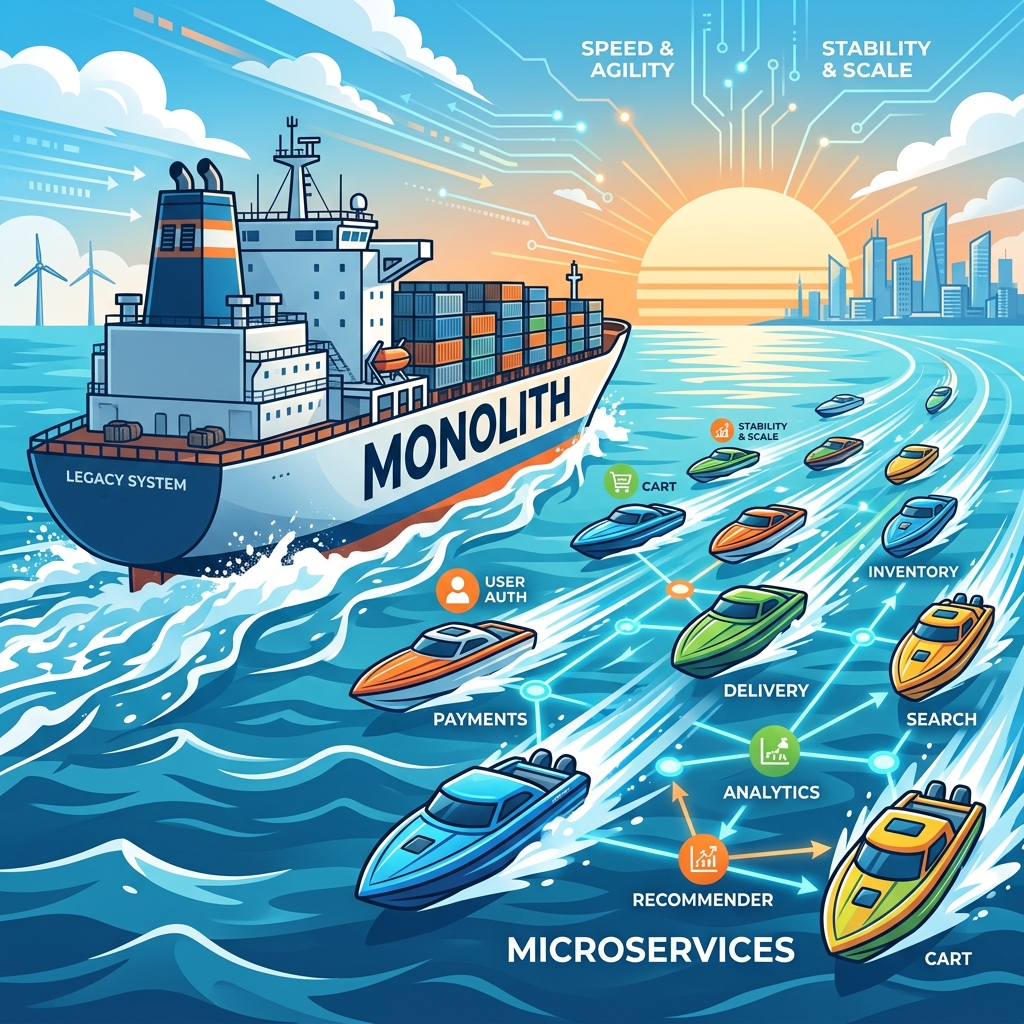
 (Image generated by AI)
The Great Architecture Debate
If you spend five minutes on software engineering Twitter, you will undoubtedly see a fierce debate about Monoliths versus Microservices.
To the uninitiated, it sounds like people are arguing over whether it’s better to live in a giant, 100-room mansion (Monolith) or a sprawling village of 100 tiny houses connected by walkie-talkies (Microservices).
Both approaches have valid use cases. Let’s break them down simply.
The Monolith: Your Reliable Mansion
A Monolithic Architecture means that your entire application—the user interface, the business logic, the database access layer, the background jobs—is bundled into a single deployable unit.
Imagine you are building an e-commerce website using Java and Spring Boot.
From-Scratch Example: A Monolith
In a Monolith, your project structure looks like this:
// Everything lives in the same project!
public class ECommerceApplication {
    public static void main(String[] args) {
        SpringApplication.run(ECommerceApplication.class, args);
    }
}

// User Auth Logic
class UserService {
    public boolean login(String username, String password) { /* ... */ }
}

// Inventory Logic
class InventoryService {
    public boolean checkStock(String productId) { /* ... */ }
}

// Billing Logic
class BillingService {
    public boolean chargeCreditCard(String userId, double amount) { /* ... */ }
}
When you hit “Deploy”, all of this code is compiled into one massive app.jar file and runs on a single server.
Why Monoliths are Great
For 90% of new startups, a Monolith is the correct choice.
- Simple to Develop: You open one project in your IDE. Everything is right there.
- Simple to Test: You can spin up the entire application locally with one click.
-
Fast Communication: When the
BillingServiceneeds to talk to theUserService, it’s just a simple method call in memory. It takes nanoseconds.
Why Monoliths Break Down
Fast forward three years. Your startup is successful. You now have 50 developers working on the same codebase.
- Every time Developer A changes the
BillingService, they accidentally break theUserService. - The
app.jartakes 45 minutes to compile. - The server crashes because the Billing team introduced a memory leak, taking down the entire website (including User Login and Inventory).
It’s time to break up the monolith.
Microservices: The Fleet of Speedboats
A Microservice Architecture takes that massive mansion and breaks it down into small, independent houses.
Instead of one ECommerceApplication, you create three completely separate applications:
UserAuthApplicationInventoryApplicationBillingApplication
Each service has its own codebase, its own server, and crucially, its own database.
How They Talk to Each Other
Because Billing and UserAuth are no longer in the same application, they can’t just call a method in memory. They have to talk over the network, usually via REST APIs (HTTP).
// Inside the Billing Microservice (Running on Server A)
class BillingService {

    // We now have to make a network request to Server B!
    public boolean chargeUser(String userId, double amount) {
        HttpClient client = HttpClient.newHttpClient();
        HttpRequest request = HttpRequest.newBuilder()
                .uri(URI.create("http://user-auth-service/api/users/" + userId + "/validate"))
                .build();

        // Wait for the network... handle timeouts... handle 500 errors...
        HttpResponse<String> response = client.send(request, BodyHandlers.ofString());

        if (response.statusCode() == 200) {
           // Charge card
        }
    }
}
Why Microservices are Great
-
Independent Scaling: If the
InventoryServiceis getting slammed with traffic on Black Friday, you can run 10 copies of just the Inventory service without paying for 10 copies of the Billing service. - Team Autonomy: The Billing team can write their service in Java, while the Machine Learning recommendation team writes theirs in Python. They don’t step on each other’s toes.
-
Fault Tolerance: If the
BillingServicecrashes, users can still log in and browse theInventory. The whole ship doesn’t sink.
The Pain of Microservices
Microservices introduce a massive amount of complexity.
- Network Latency: Method calls take nanoseconds. HTTP requests take milliseconds.
- Distributed Tracing: When a request fails, it’s incredibly hard to figure out which of the 15 microservices caused the error.
-
Data Consistency: You can no longer use simple database joins (
SELECT * FROM Users JOIN Inventory) because the data lives in completely different databases on different servers!
Conclusion
Start with a Monolith. Build your product, find your market fit, and keep things simple. Only migrate to Microservices when your team size or scaling bottlenecks physically force you to. Remember: you are not Google, and you probably don’t need 500 microservices to run a blog.