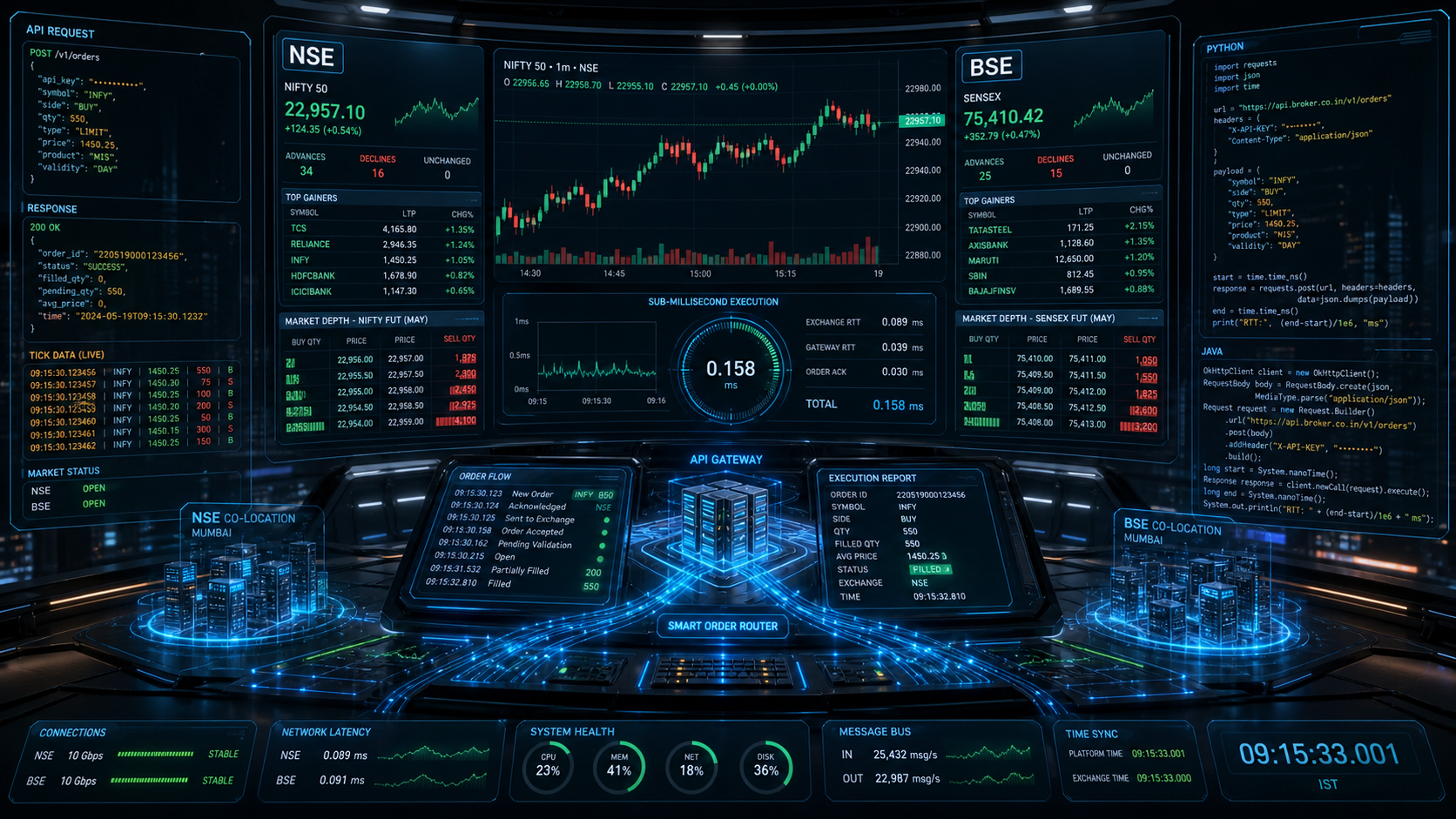
 (Comprehensive Comparison of Top Algorithmic Trading API Platforms in India)
(Image generated by AI)
Introduction: The Algo Trading Boom in India
Algorithmic trading is no longer exclusive to Wall Street hedge funds or high-frequency trading (HFT) firms in Mumbai’s Bandra Kurla Complex (BKC). Over the past three years, the Indian retail trading landscape has witnessed a seismic shift.
With the Securities and Exchange Board of India (SEBI) establishing formal framework guidelines for retail automated trading and discount brokers opening up their internal Application Programming Interfaces (APIs), everyday software engineers, quantitative analysts, and retail traders can now connect custom algorithms directly to the National Stock Exchange (NSE), Bombay Stock Exchange (BSE), and Multi Commodity Exchange (MCX).
Whether you want to build a simple Python script to automatically rebalance your equity portfolio, deploy a mean-reverting options trading strategy on Nifty and Bank Nifty, or build a production Java engine that streams tick-by-tick market depth over WebSockets, your choice of broker API will make or break your trading system.
+--------------------------------------------------------------------------------+
|                        THE ALGORITHMIC TRADING STACK                           |
+--------------------------------------------------------------------------------+
|                                                                                |
|  [ Your Trading Logic ] (Python / Java / Node.js / C# / Go)                    |
|            |                                                                   |
|            v  (REST Orders & WebSocket Ticks)                                  |
|  [ Broker Trading API ] (Zerodha / Shoonya / Angel One / Dhan / Upstox / Fyers)|
|            |                                                                   |
|            v  (FIX / Native Exchange Protocol)                                 |
|  [ Indian Exchanges ] (NSE / BSE / MCX Engine)                                 |
|                                                                                |
+--------------------------------------------------------------------------------+
A poor API choice can lead to:
- Hefty recurring costs (e.g., paying ₹4,000/month in API fees before making your first rupee in profit).
- Silent WebSocket disconnections and dropped price updates during volatile market open hours (9:15 AM to 9:30 AM IST).
- Aggressive rate-limiting that throttles your orders during rapid market crashes.
- Painful integration hurdles due to missing SDKs, broken endpoints, or outdated documentation.
In this definitive guide, we review and benchmark the top 6 algorithmic trading API providers in India: Shoonya (Finvasia), Zerodha (Kite Connect), Angel One (SmartAPI), Dhan (DhanHQ), Upstox (API v2), and Fyers (API v3).
By the end of this article, you will understand the exact trade-offs in pricing, rate limits, latency, and developer experience so you can choose the right API for your capital and strategy.
The 6 Evaluation Criteria: How to Judge a Trading API
Before comparing individual brokers, you must evaluate APIs across six objective technical and financial pillars:
1. Total Cost of Ownership (API Subscription + Brokerage)
Many beginners forget that broker charges come in two parts:
- API Subscription Fee: A recurring monthly charge simply to keep your API keys active.
- Per-Trade Brokerage: The fee deducted every time your algorithm buys or sells contracts (typically ₹0 to ₹20 per executed order). If you deploy an intraday scalping strategy executing 30 orders a day, a ₹20/order broker will cost you ₹600/day (over ₹13,000/month) in brokerage alone, regardless of whether your strategy makes money.
2. Rate Limits (Requests Per Second)
Exchanges and brokers strictly limit how many HTTP requests your bot can send per second. A low rate limit (e.g., 3 to 5 requests/sec) will choke multi-leg options execution or portfolio scanners. High-frequency algorithms need at least 20 to 50 requests/sec.
3. Real-Time Streaming (WebSockets)
Does the broker offer full-duplex WebSocket feeds? Are the ticks streamed as lightweight JSON or high-performance binary formats (like Google Protocol Buffers)? Does the broker enforce strict socket concurrency limits (such as allowing only 1 socket per account)?
4. Developer Experience & Multi-Language SDKs
Does the broker provide officially maintained, well-tested client libraries in languages like Python, Java, Node.js, Go, and C#? Or are you forced to write raw HTTP networking and cryptographic SHA-256 signatures from scratch?
5. Morning Peak Stability (The 9:15 AM Stress Test)
Indian markets open at 9:15 AM IST with an intense burst of order placements, index re-pricing, and options contract recalculations. Several brokers experience latency spikes, gateway timeouts (502 Bad Gateway), or frozen WebSocket connections between 9:15 AM and 9:30 AM.
6. Historical Data Access & Paper Trading Sandbox
To develop profitable strategies, you need years of 1-minute historical candlestick data for backtesting. Some brokers include free historical data in their basic API, while others charge an expensive monthly add-on fee.
Master Comparison Matrix: Top 6 Algo Trading APIs in India
Here is the side-by-side technical and financial breakdown of India’s leading API brokers:
| Feature / Broker | Shoonya (Finvasia) | Zerodha (Kite Connect) | Angel One (SmartAPI) | Dhan (DhanHQ) | Upstox (API v2) | Fyers (API v3) |
|---|---|---|---|---|---|---|
| API Subscription | ₹0 (Free Lifetime) | ₹2,000 / month | ₹0 (Free Lifetime) | ₹0 (Free Lifetime) | ₹0 (Free) | ₹0 (Free Lifetime) |
| Historical Data Fee | Included (Free) | +₹2,000 / month | Included (Free) | Included (Free) | Included (Free) | Included (Free) |
| Equity Delivery | ₹0 (Zero Brokerage) | ₹0 (Zero) | ₹0 (Zero) | ₹0 (Zero) | ₹20 or 2.5% | ₹0 (Zero) |
| Intraday & F&O | ₹0 (True Zero) | ₹20 per order | ₹20 per order | ₹20 per order | ₹20 per order | ₹20 per order |
| Rate Limit | ~10 req / sec | 3 to 10 req / sec | 10 to 20 req / sec | Up to 100 req / sec | ~10 req / sec | ~10 req / sec |
| WebSocket Streaming | Live Touchline & Depth | Live Ticks (Binary) | Live Ticks (Binary 2.0) | Live Ticks (Binary) | Protobuf / JSON | Live Ticks (Binary) |
| Official SDKs | Java, Python (Community) | Python, Java, Node, Go | Python, Java, Node, C# | Python, Node, Java | Python, Java, Node, PHP | Python, Node |
| TradingView Webhook | Manual Build | Via Third-Party Tools | Via Third-Party Tools | Built-in Native | Via Third-Party Tools | Built-in Native |
| Target Audience | Cost-Conscious / High-Vol | Institutional / Retail | Full-Service Traders | Quants & Chart Traders | Tech-First Developers | Chart & Options Traders |
In-Depth Provider Reviews
1. Shoonya by Finvasia: The Zero-Brokerage Powerhouse
Shoonya (powered by financial technology firm Finvasia) has become a sensation among quantitative developers and retail traders due to its uncompromising true zero-brokerage pricing model.
+--------------------------------------------------------------------------------+
|                        SHOONYA (FINVASIA) AT A GLANCE                          |
+--------------------------------------------------------------------------------+
|  API Subscription Cost : ₹0 (Lifetime Free)                                    |
|  Brokerage Charge      : ₹0 on Equity Delivery, Intraday, Futures & Options    |
|  Historical Data       : Free (1-minute bars via API)                          |
|  Streaming Gateway     : WebSocket (NorenWSAPI)                                |
|  Official Documentation: https://shoonya.com/api                               |
+--------------------------------------------------------------------------------+
Unlike traditional discount brokers that charge ₹20 per executed order, Shoonya charges ₹0 across every market segment—Equity Delivery, Equity Intraday, Index Futures, Stock Futures, Options, and Commodities (MCX). Furthermore, API access is 100% free with no recurring monthly maintenance charges.
Technical Highlights:
- Built on the battle-tested Noren OMS platform.
- Provides standard REST endpoints alongside persistent WebSocket market streaming via
wss://api.shoonya.com/NorenWSAPI/. - Fast single-use OAuth 2.0 authorization code exchange (
/GenAcsTok) paired with standard RFC 6238 TOTP two-factor authentication.
Pros:
- Zero Financial Drag: You pay zero brokerage fees and zero API fees. If you place 100 trades a day, you save ₹2,000 every single trading session compared to Zerodha or Angel One.
- Free Historical Data: Access historical bar data without purchasing extra data packs.
- Direct Multi-Asset Access: Connect to NSE, BSE, and MCX through a unified API token system.
Cons:
-
Documentation Requires Patience: Official documentation can be brief, and several legacy endpoints (like
QuickAuthorNorenWSTP) are deprecated, requiring developers to follow updated community guides. - Single-Socket Constraint: Strictly permits only one active WebSocket connection per User ID. Having the mobile app or web portal open will interfere with your stream.
- Minimal Community Tooling: Unlike Zerodha, there is no sprawling ecosystem of third-party open-source plugins; you often have to write your own wrapper in Java or Python.
Best Suited For: Developers, options scalpers, high-frequency quantitative systems, and retail traders with modest capital who cannot afford monthly API fees and per-trade brokerage eating into their edge.
Official Links:
- Website: Shoonya (Finvasia) Official Portal
- Developer Docs: Shoonya API Documentation
- Trading Terminal: Shoonya Web Trading Terminal (PRISM)
- Official GitHub: Shoonya Official Java SDK on GitHub
2. Zerodha (Kite Connect): The Industry Benchmark for Stability
Zerodha is India’s largest discount broker, and its proprietary Kite Connect API is widely regarded as the gold standard for developer experience, documentation clarity, and architectural elegance.
+--------------------------------------------------------------------------------+
|                          ZERODHA KITE CONNECT AT A GLANCE                      |
+--------------------------------------------------------------------------------+
|  API Subscription Cost : ₹2,000 / month                                        |
|  Historical Data Add-on: ₹2,000 / month extra                                  |
|  Brokerage Charge      : ₹0 Delivery | ₹20 or 0.03% on Intraday / F&O           |
|  Streaming Gateway     : High-speed Binary WebSocket                           |
|  Official Documentation: https://kite.trade/                                   |
+--------------------------------------------------------------------------------+
Zerodha’s Kite Connect ecosystem is mature, polished, and supported by a massive developer forum. If you run into an error or edge case, chances are someone has already solved and documented it on the Kite developer forum.
Technical Highlights:
- High-performance binary WebSocket feed streaming packed byte buffers that decode directly into tick structs with minimal CPU overhead.
- Officially maintained, idiomatic SDKs in Python (
pykiteconnect), Java (kiteconnect-java), Node.js, Go, and PHP. - Robust Publisher API allowing fintech startups to build “Click to Execute” buttons directly into websites and apps.
Pros:
- Unrivaled Reliability: Excellent uptime and server resilience during peak 9:15 AM market volatility.
- World-Class Documentation: Comprehensive guides, clear error codes, interactive API consoles, and transparent changelogs.
- Vibrant Community: Active official developer forums where Zerodha core engineers frequently answer architectural questions.
Cons:
- Steep Pricing: Costs ₹2,000/month for basic Kite Connect API access, plus an additional ₹2,000/month if your strategy requires historical candlestick data. That is ₹48,000 per year in static API costs alone!
- Strict Rate Limits: Limits order placement to 3 requests per second and general HTTP queries to 10 requests per second.
Best Suited For: Well-capitalized quantitative traders, financial institutions, fintech startups, and developers who prioritize platform stability, battle-tested libraries, and comprehensive documentation above all else.
Official Links:
- Developer Portal: Zerodha Kite Connect Developer Portal
- Broker Website: Zerodha Official Website
- Kite Forum: Kite Developer Community Forum
3. Angel One (SmartAPI): The Enterprise Full-Service Free Alternative
Angel One (formerly Angel Broking) transitioned from a traditional full-service brokerage into a digital powerhouse with its SmartAPI initiative.
+--------------------------------------------------------------------------------+
|                          ANGEL ONE SMARTAPI AT A GLANCE                        |
+--------------------------------------------------------------------------------+
|  API Subscription Cost : ₹0 (Free Lifetime Access)                             |
|  Brokerage Charge      : ₹0 Delivery | ₹20 per order on Intraday & F&O          |
|  Historical Data       : Free (Included with SmartAPI)                         |
|  Streaming Gateway     : SmartAPI WebSocket 2.0 (Binary Stream)                |
|  Official Documentation: https://smartapi.angelbroking.com/                    |
+--------------------------------------------------------------------------------+
Angel One was the first mainstream legacy broker to make its professional trading API completely free for retail traders, directly challenging Zerodha’s subscription model.
Technical Highlights:
- Generous rate limits (typically up to 20 requests per second across various endpoints).
- Recently overhauled WebSocket 2.0 streaming gateway that delivers binary-packed ticks across touchline and market depth.
- Full support for multi-leg GTT (Good-Till-Triggered) orders directly via the API.
Pros:
- Free API & Historical Data: Zero monthly recurring API fees, with historical candle data included for free.
- Broad Multi-Language SDK Support: Official libraries for Python, Java, Node.js, C#, Go, and R.
- Full-Service Infrastructure: Access to institutional research, mutual funds, and IPO APIs under a single umbrella.
Cons:
- Session Expiration Traps: JWT authentication tokens expire frequently, requiring your bot to implement automatic token refresh flows.
- Brokerage Still Applies: Flat ₹20 per executed order on Intraday and F&O trades.
- Customer Support: Developer support via forums can sometimes be slower compared to dedicated tech-first brokers.
Best Suited For: Traders who want a free API backed by an established, publicly listed broker with a large asset base and official multi-language SDK support.
Official Links:
- Developer Portal: Angel One SmartAPI Portal
- Official Website: Angel One Official Website
- SmartAPI GitHub: Angel One GitHub Organization
4. Dhan (DhanHQ): The Quant-First Modern Innovator
Launched by Raise Financial Services, Dhan has rapidly established itself as the preferred broker for modern technical traders, active options buyers, and quantitative engineers through its DhanHQ API platform.
+--------------------------------------------------------------------------------+
|                            DHAN (DHANHQ) AT A GLANCE                           |
+--------------------------------------------------------------------------------+
|  API Subscription Cost : ₹0 (Lifetime Free for All Users)                      |
|  Brokerage Charge      : ₹0 Delivery | ₹20 per order on Intraday / F&O         |
|  Historical Data       : Free Daily & Intraday Candles                         |
|  Rate Limits           : Up to 100 requests per second!                        |
|  Official Documentation: https://dhanhq.co/                                    |
+--------------------------------------------------------------------------------+
Dhan was engineered from the ground up for active retail traders. It features native webhook integration with TradingView, allowing users to fire programmatic orders straight from custom Pine Script alerts without hosting a dedicated server.
Technical Highlights:
- Industry-Leading Rate Limits: Allows up to 100 requests per second for quote requests and 25 requests/sec for order placement—far surpassing traditional broker limits.
- Native Webhooks: Place multi-leg basket orders directly from TradingView alerts with simple JSON payloads.
- Dedicated Developer Dashboard: Clean, intuitive UI for generating 30-day API access tokens with fine-grained permission toggles.
Pros:
- Zero API Fees: 100% free API and market data feeds for all active Dhan account holders.
- Blazing Fast API Limits: Designed specifically for multi-symbol market scanners and fast order dispatch.
- Superb Options Features: Dedicated options chain endpoints that provide strike prices, implied volatility (IV), Greeks, and open interest (OI) in a single API call.
- Discount for Women Traders: Offers a 50% discount on brokerage for women account holders.
Cons:
- Flat Brokerage: Charges ₹20 per order on intraday and derivative trades.
- Relatively New Broker: Shorter track record compared to legacy institutions like Angel One or Zerodha.
Best Suited For: Active options traders, quantitative backtesters, TradingView Pine Script developers, and multi-symbol intraday scanners.
Official Links:
- Developer Portal: DhanHQ Developer Platform
- Official Website: Dhan Official Website
- API Documentation: DhanHQ API Documentation
5. Upstox (Developer API v2): Cloud-Native & Protobuf Feeds
Backed by institutional investors like Tiger Global and Ratan Tata, Upstox launched its overhauled API v2, featuring modern REST architectural patterns and binary streaming.
+--------------------------------------------------------------------------------+
|                           UPSTOX (API V2) AT A GLANCE                          |
+--------------------------------------------------------------------------------+
|  API Subscription Cost : Free for Basic Trading API                            |
|  Brokerage Charge      : ₹20 per order on Equity Intraday & F&O                |
|  Historical Data       : Free historical candle endpoints                      |
|  Streaming Format      : Google Protocol Buffers (Protobuf)                    |
|  Official Documentation: https://upstox.com/developer/api-documentation/      |
+--------------------------------------------------------------------------------+
Upstox API v2 stands out because of its modern engineering: it uses standard OAuth 2.0 Authorization Code flows and Google Protocol Buffers (Protobuf) for streaming WebSocket data.
Technical Highlights:
- Protobuf Serialization: Instead of raw JSON strings, market data is serialized using Protobuf, drastically reducing packet sizes and parsing overhead for high-frequency processing.
- Clean OpenAPI (Swagger) specifications allowing developers to generate clients in any programming language automatically.
- Robust portfolio, holdings, and order management webhooks.
Pros:
- Modern Architecture: Strictly conforms to RFC standards (OAuth 2.0, Protobuf, RESTful conventions).
- Fast WebSocket Feeds: Binary streams minimize network bandwidth consumption.
- Officially Maintained Libraries: Good SDK support for Python, Java, Node.js, and PHP.
Cons:
-
Protobuf Complexity for Beginners: Beginners unfamiliar with
.protoschema compiling may find parsing WebSocket market data more challenging than standard JSON. - Delivery Brokerage: Unlike Zerodha or Shoonya, Upstox charges up to ₹20 or 2.5% (whichever is lower) on equity delivery trades.
Best Suited For: Seasoned software engineers and fintech developers who appreciate strict OpenAPI specifications and modern cloud serialization protocols like Protobuf.
Official Links:
- Developer Documentation: Upstox API Documentation
- Official Website: Upstox Official Portal
- Upstox GitHub: Upstox GitHub Organization
6. Fyers (API v3): Built by Traders for Visual & Options Analysts
Fyers was among the earliest discount brokers in India to champion trading directly from charts. Their Fyers API v3 provides deep integration with TradingView and advanced options analytics.
+--------------------------------------------------------------------------------+
|                            FYERS (API V3) AT A GLANCE                          |
+--------------------------------------------------------------------------------+
|  API Subscription Cost : ₹0 (Free Lifetime Access)                             |
|  Brokerage Charge      : ₹0 Delivery | ₹20 per order on Intraday / F&O         |
|  Historical Data       : Free (Up to 5+ years of historical intraday data)     |
|  Official Documentation: https://fyers.in/fyers-api/                           |
+--------------------------------------------------------------------------------+
Technical Highlights:
- High-speed WebSocket service with market depth and index tick feeds.
- Extensive historical database providing multi-year 1-minute historical data for backtesting.
- Built-in multi-leg options strategy execution endpoints.
Pros:
- Free API Access: No monthly subscription fee.
- Deep Historical Data: Offers some of the longest historical intraday data ranges among free Indian broker APIs.
- TradingView Integration: Seamless chart sync between your automated bot trades and manual chart monitoring.
Cons:
- Morning Open Latency: Users occasionally report WebSocket reconnection loops during the 9:15 AM to 9:20 AM opening bell.
- Brokerage Costs: Standard ₹20/order applies to intraday and F&O.
Best Suited For: Traders migrating from manual TradingView charting to automated rule-based execution who need deep historical data for backtesting.
Official Links:
- Developer Portal: Fyers API Official Portal
- Official Website: Fyers Official Website
- Community Forum: Fyers Community Forum
Decision Matrix: Which API Should YOU Choose?
To make an informed decision based on your trading style and capital, use this practical recommendation guide:
| If Your Primary Need Is… | Recommended Broker API | Key Advantage |
|---|---|---|
| Maximum Cost Savings & Scalping | Shoonya (Finvasia) | Pay ₹0 API fee and ₹0 brokerage per trade across all segments. |
| Enterprise Stability & Documentation | Zerodha (Kite Connect) | Gold-standard uptime, mature SDKs, and huge community support. |
| High Request Volume & Options Analytics | Dhan (DhanHQ) | Free API, 100 req/sec limits, Greeks, and native TradingView webhooks. |
| Full-Service Safety with Free APIs | Angel One (SmartAPI) | Backed by a large listed institution with free APIs and multi-language SDKs. |
| Cloud-Native Protobuf Streaming | Upstox (API v2) | Clean OpenAPI specs and binary Protocol Buffer WebSocket feeds. |
| Chart-Driven & Long Historical Backtests | Fyers (API v3) | Free multi-year 1-minute historical data and deep TradingView chart sync. |
1. Choose Shoonya (Finvasia) If:
- You are a retail trader with capital under ₹5,00,000 where ₹20/order brokerage would eat up a substantial percentage of your profits.
- You trade high-frequency, multi-leg options strategies or scalping algorithms generating dozens of orders per session.
- You want completely free historical candlestick data and real-time tick streaming without recurring subscriptions.
2. Choose Zerodha (Kite Connect) If:
- You are running a professional, well-capitalized fund or startup where spending ₹4,000/month for API and historical data is negligible.
- You want the peace of mind that comes with India’s largest, most battle-tested algorithmic trading infrastructure.
- You need official SDKs in Go, Java, Python, or Node.js with extensive StackOverflow and forum documentation.
3. Choose Dhan (DhanHQ) If:
- You need super-fast rate limits (up to 100 requests/sec) for scanning broad indices and symbol watchlists.
- You build strategies in TradingView Pine Script and want instant webhook order execution without maintaining a middle-tier server.
- You need direct API access to live options chains and Greeks without calculating them yourself.
Technical Pitfalls to Watch Out For
Regardless of which API provider you select, every algorithmic trader in India must prepare for these common technical challenges:
-
Mandatory 2FA (TOTP) Automation:
Per SEBI regulations, all API logins require Two-Factor Authentication. Avoid manual SMS OTPs. Configure automated RFC 6238 TOTP generators using your broker’s Base32 secret key so your bot can log in autonomously every morning at 8:45 AM before market open. -
The IPv6 Network Firewall Trap:
Indian ISPs (Jio Fiber, Airtel Xstream) frequently assign dynamic IPv6 addresses. If your broker’s developer dashboard requires IP whitelisting (like Shoonya or Angel One), ensure your application forces outbound IPv4 connections (-Djava.net.preferIPv4Stack=truein Java) to prevent mysterious"Access Restricted"rejections. -
Session Lifespans:
Broker access tokens are single-day tokens that expire every night between 3:30 AM and 6:00 AM IST. Never hardcode tokens; always build an automated daily authentication pipeline. -
WebSocket Concurrency Rules:
Brokers like Shoonya permit only one active socket per User ID. If your bot disconnects or crashes unexpectedly, always ensure background processes are terminated before attempting to reconnect.
Conclusion & Next Steps
There is no single “best” trading API for everyone—the optimal choice depends on your trading frequency, capital base, and technical expertise:
- For pure cost efficiency and algorithmic scalping, Shoonya by Finvasia provides unmatched value with lifetime zero brokerage and zero API charges.
- For enterprise reliability and community documentation, Zerodha Kite Connect remains the industry benchmark.
- For high-speed scanning and modern options analytics, DhanHQ leads the new wave of fintech brokers.
Ready to Start Building?
- Check out our Complete Guide to Shoonya API Authentication in Java to master automated TOTP 2FA, OAuth token exchanges, and IPv6 network fixes.
- Learn how to stream real-time tick-by-tick prices in our Shoonya Java WebSocket Market Data Streaming Guide.
- Review risk management rules and paper trading strategies in our Beginner’s Roadmap to Algorithmic Trading.
Which broker API are you currently using or considering for your automated strategies? Share your thoughts or questions in the comments below!